Beyond single cards
Combinations & Spread Builder
A single card is a word; two cards make a sentence. Pair any cards in the deck for a combination reading, then design a spread whose positions actually match your question.
78
Cards in the deck
22
Major Arcana
56
Minor Arcana
3,003
Possible pairs
Combination workshop
The Tower with The Star
- · A Major Arcana card in the pair raises the stakes: this is not a passing mood but a chapter heading.
- · A sudden truth removes a false structure. Painful, necessary, and finally honest.
- · After the rupture, clear sky. Small faith, kept nightly, restores everything.
The tension is scale: two Major Arcana cards describe a long chapter, so resist reading this as a single week's event.
Advice: Write down what has changed over the past few months before deciding what the next step is.
Build your own spread
Choose up to seven positions (3 selected)
Ground
People
Forces
Time
Action
Reader's drills
The two-card drill
Draw two cards daily with no question. Write one sentence joining them. After thirty days you will read pairs faster than you read single cards.
Cover the book
Describe the image before you recall the meaning. What is the figure doing, where are they looking, what is behind them? Meaning that comes from the picture sticks.
Name the failure mode
For each card, state how it goes wrong. The Sun becomes glare; the Empress becomes smothering. Reversals stop being mysterious once you can do this.
Read the gaps
Note which suit is missing from a spread. Absence is information — a love spread with no Cups is about something other than feeling.
One-week verification
Record the reading, then revisit it in seven days and mark what matched. Nothing improves a reader faster than being checked.
In short
Pair any two of the 78 tarot cards for a combination reading, build a custom spread from eighteen positions, and drill the skills that make a reader fluent.
- Repeated numbers across a spread are a stronger signal than any single card: three fives means instability, whatever the suits.
- A reversal is best read as the card's energy blocked, delayed or turned inward, not as its opposite.
- When two cards genuinely contradict, say so out loud. Contradiction is information, not a failure of the reading.
- Court cards next to each other usually describe a dynamic between people rather than two separate individuals.
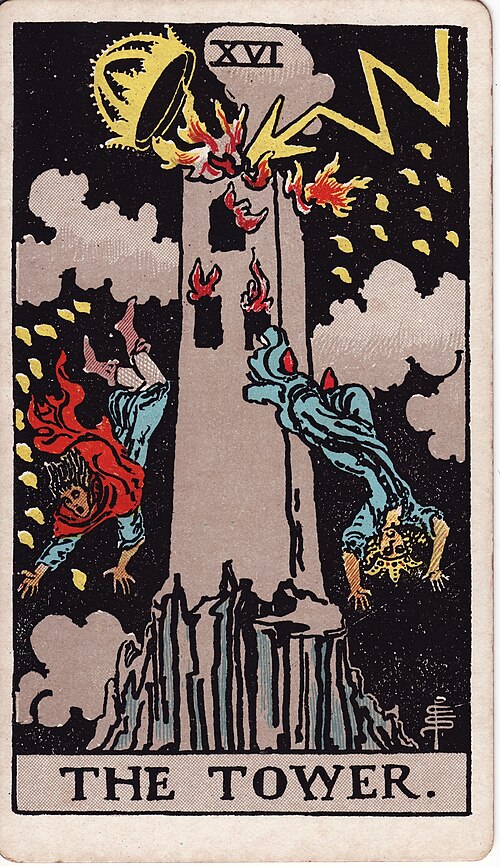
The Tower

The Star


78
Cards in the deck
3,003
Possible pairs
18
Builder positions
≤7
Cards per spread
Origins
Reading cards in combination is older than reading them singly. The Lenormand tradition never treated a card as meaningful alone — the Ship plus the House is a move, not a boat and a building — and the earliest tarot spreads inherited the same habit from cartomancy played with ordinary playing cards.
The single-card-with-a-keyword approach is largely a twentieth-century publishing convention. Little white books needed one paragraph per card, which trained readers to treat seventy-eight cards as seventy-eight separate essays rather than as a vocabulary designed to be combined into sentences.
Custom spread design has a similar history. A. E. Waite published the Celtic Cross in The Pictorial Key to the Tarot in 1910; its earlier origins are uncertain, and it is not a proven ancient pattern. Treating it as fixed scripture obscures the point: positions are questions, and you can always ask better questions than someone else asked in 1910.
The Method
Read each card alone first
Get one honest sentence for each before you try to join them. Combination reading built on vague singles just multiplies the vagueness.
Name the relationship
Are the two cards agreeing, arguing, or describing cause and effect? That choice does most of the interpretive work.
Watch the suits
Two of the same suit intensify; fire and water together describe a conflict between wanting and feeling.
Let majors set the register
A major beside a minor tells you the small thing belongs to a larger story. Two majors together mean the situation is not really about the details.
Design positions before you shuffle
Write the questions you actually want answered, in the order you want them answered. Three good positions beat ten borrowed ones.
Finish with one sentence
If you cannot compress the spread into a single sentence, you have not finished reading it.
Practice Notes
- Repeated numbers across a spread are a stronger signal than any single card: three fives means instability, whatever the suits.
- A reversal is best read as the card's energy blocked, delayed or turned inward, not as its opposite.
- When two cards genuinely contradict, say so out loud. Contradiction is information, not a failure of the reading.
- Court cards next to each other usually describe a dynamic between people rather than two separate individuals.
- Keep custom spreads under seven cards. Beyond that most readers are pattern-matching rather than reading.
Myth & Truth
Commonly said
There is an official meaning for every card pair.
In practice
There are thousands of pairs. What exists is a method for combining, not a lookup table.
Commonly said
Some spreads are more powerful than others.
In practice
A spread is a set of questions. Better questions give better readings; there is no power in the geometry.
Commonly said
Reversed cards are negative.
In practice
Reversal describes direction and intensity. Plenty of reversed cards are a relief.
Commonly said
A combination reading predicts what will happen.
In practice
It is offered for reflection and entertainment. Treat it as a structured way of thinking, not a forecast.
Questions Readers Ask
How many cards can I combine at once?
Two is a sentence, three is a paragraph. Past seven, split the spread into groups and read each group first.
Should I use reversals in a custom spread?
Only if you can read them consistently. Half the tradition works entirely upright.
What if two cards seem to cancel out?
That is usually the reading: the situation is genuinely stalled between two pulls.
Is this the same as the daily draw?
No. The draw gives you cards; this page is about how to make them speak to each other.
Continue the Thread
Read the cards in context
A card's meaning changes with the question and its position in a spread. The same image can describe a resource, an obstacle or an action to consider. Name the question first, then notice the card's figures, objects and direction of movement. Keywords are a starting vocabulary, not a verdict about what must happen.
For a pair, compare the two themes before blending them: do they reinforce each other, introduce a contrast, or suggest a possible sequence? Read both orientations and state what evidence in your situation would support each. Reversals may indicate blockage, excess or an inward focus; they do not automatically turn every yes into a no.
No spread can reliably reveal someone else's private feelings or give a guaranteed date. If a reading leads to a useful insight, choose one small action and review the outcome later. Repeated draws for the same question can increase confusion rather than certainty. Do not use cards as a substitute for medical, legal or financial advice.
For example, the Tower and the Star can be read as disruption alongside hope and renewal. In a situation-and-advice spread, that might invite you to acknowledge what changed and identify available support. In two obstacle positions, the same cards could raise questions about instability and unrealistic expectations. The positions change the reading; the pair does not promise disaster followed by rescue.
What observable action follows from this reading, and what would make me reconsider it?