Chiromancy
Read the Hand
Every hand carries a map drawn before you could read. Photograph your open palm in even light and the lines are read from the image itself.
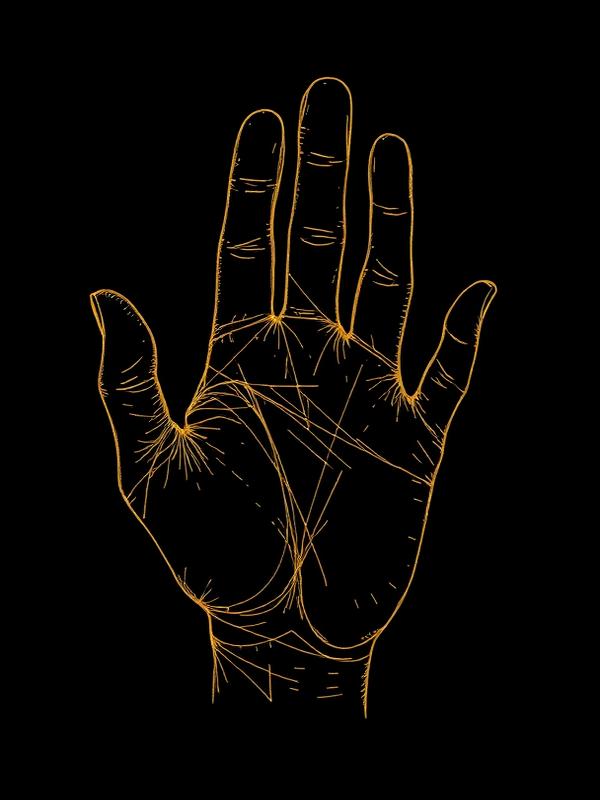
Upload a photograph
Open the hand fully, fingers relaxed and slightly apart, in soft even light without flash. Photograph your dominant hand for the present, the other for what you were given.
Your photograph is read once to produce this interpretation and is never stored.
In short
Upload a photograph of your palm and receive a line-by-line chiromancy reading of the heart, head, life and fate lines.
- Lines change over years. Photograph both palms annually if you want real evidence.
- A short life line has no relationship to lifespan; it describes vitality and constitution in traditional practice.
- Deep clear lines are read as strong currents; fragmented ones as interrupted ones.
- Read in natural light with the hand relaxed, not stretched flat.
3
Major lines
7
Classical mounts
4
Hand types
1900
Benham's system
The major lines and what each governs
Depth and clarity carry more weight than length in every school; a faint line is read as an under-used capacity.
| Line | Where it runs | Governs |
|---|---|---|
| Life | Curves around the thumb mount | Vitality, constitution, big changes |
| Heart | Across the top of the palm | Attachment style, emotional appetite |
| Head | Across the middle of the palm | Thinking style, focus, decisions |
| Fate | Rises vertically to the middle finger | Career direction, sense of calling |
| Sun | Rises toward the ring finger | Recognition, creative satisfaction |
| Marriage | Short marks below the little finger | Significant bonds, not weddings |
Chiromancy appears in Indian, Chinese, Greek and Roman sources, and reached its most systematic European form in the nineteenth century, when Casimir d'Arpentigny and William Benham built elaborate classifications of hand shape, mount and line. Benham's 1900 volume remains the reference most modern readers work from.
The hand does record real information — occupation, health, habit, handedness — which is part of why the practice persists. The traditional claim goes further, reading temperament and timing from line length, depth and branching.
Hast Samudrika, the Indian hand-reading tradition, is the oldest continuous strand and travelled west through Romani practice into medieval Europe, where church authorities banned it repeatedly and unsuccessfully. Chinese hand reading developed separately alongside face reading as a diagnostic art.
Victorian chirology gave the practice its modern vocabulary — the planetary mounts, the named major lines — largely through the showman Cheiro, who read hands for Mark Twain and Oscar Wilde. Almost every English-language palmistry book since repeats his framework.
Hand reading appears in Indian sources as hasta samudrika shastra, in Chinese physiognomy, and in Greek texts attributed to Aristotle. It reached Victorian drawing rooms through Casimir d'Arpentigny's work on hand shapes and Cheiro's celebrity practice, which is where the familiar named lines and mounts were fixed into their modern form.
One finding survives from the medical side of the story: the crease patterns of the hand form before birth and are shaped by the same developmental period as several other systems, which is why clinicians still note unusual palmar creases. That is a long way from the claim that a line predicts an event, but it is why the lines are not arbitrary.
Questions Readers Ask
Which hand should be read?
Both. The non-dominant hand for inherited disposition, the dominant one for the life as it has actually been lived.
What are the four hand types?
Earth, air, fire and water, determined by the ratio of palm length to finger length and by skin texture.
Can palmistry diagnose illness?
No. Some clinical signs appear in the hands, but reading them is medicine, not chiromancy — see a doctor.
Which hand should be read?
The dominant hand for the present and for what you have made; the other for inheritance and disposition. The differences between them are the reading.
Do the lines really change?
The three major lines are set early and stay stable. The fine secondary lines demonstrably shift over years, which is why practitioners re-read the same hand across a life.
Which hand should I read first?
The dominant one, because it describes what you are actively doing. Then compare with the non-dominant hand for inherited temperament, and read the gap between them.
Can lines really change?
The three major creases are stable, but fine lines, chains and islands come and go over months. Readers treat those as the changeable layer and the major creases as the frame.